
Every hotel renovation comes down to a truth that surprises first time owners and never surprises anyone who has done it twice. The building work is the part everyone talks about, but the furniture, the linen, the curtains, the towels and the thousand small operating items are what actually decide whether you reopen on time and on budget.
This is the world of FF&E and OS&E, and if you are planning a hotel renovation, it deserves far more attention than it usually gets. This guide covers what these two categories mean, how they behave differently in a renovation than in a new build, where the money goes, where the time goes, and how to run the whole process without drowning in suppliers. It is written for owners and operators refreshing an existing property, because the renovation buyer faces a specific set of problems that the general guides tend to skip.
What FF&E and OS&E actually mean
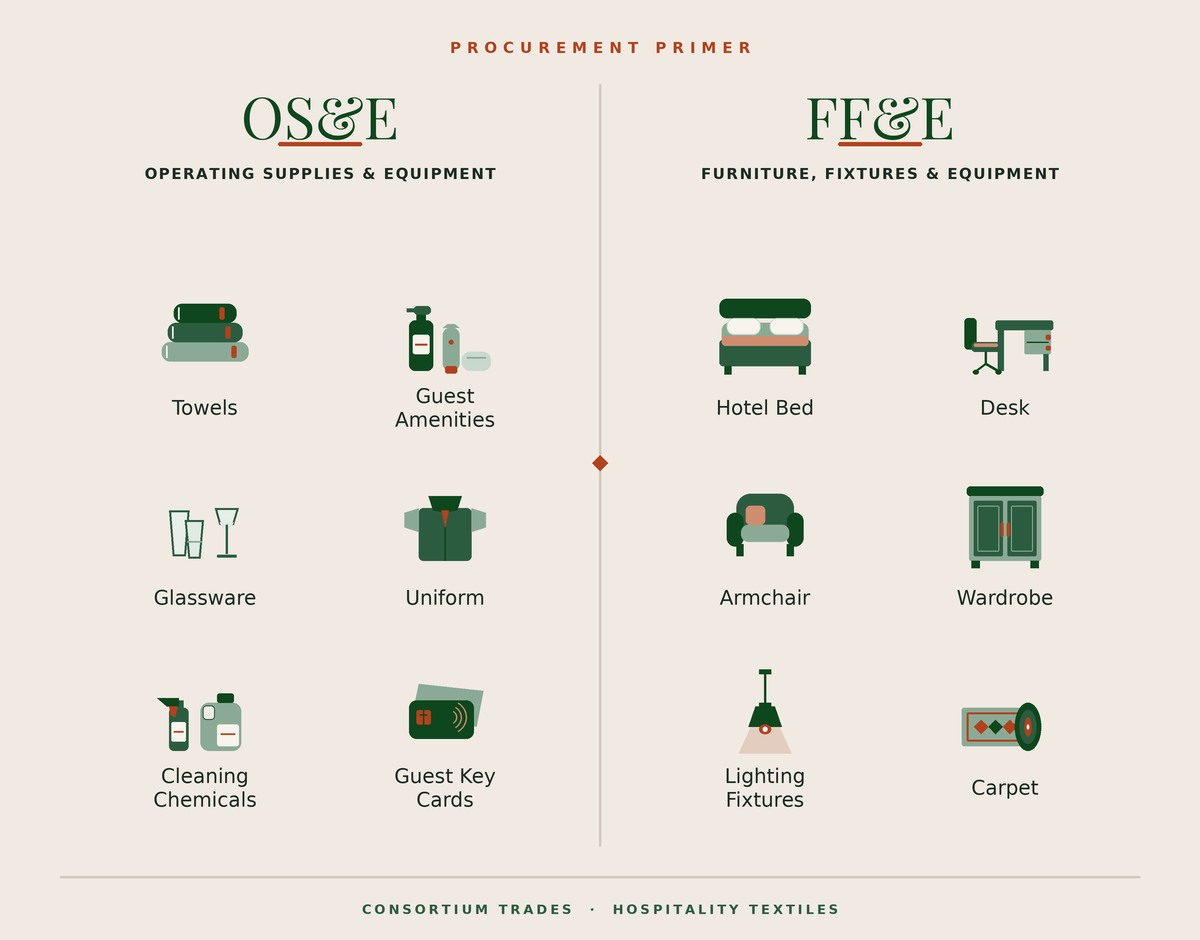
FF&E stands for Furniture, Fixtures and Equipment. It covers everything that shapes the look and feel of the hotel and that a guest physically touches or sits on. Beds and headboards, wardrobes and desks, armchairs and desk chairs, lighting, mirrors, curtains and soft furnishings all sit here. These are the pieces that carry your brand and your guest experience, and they are usually the single largest line in a renovation budget.

OS&E stands for Operating Supplies and Equipment. This is the operational layer that makes the hotel actually function once the doors open. Towels, bathrobes, bed linen, slippers, and the full inventory of items housekeeping and the front desk rely on every day. Individually these items look small and cheap. Collectively they are anything but, and they are the most consistently underestimated part of any hotel project.
The simplest way to hold the difference in your head is this. FF&E is what the guest sees and remembers. OS&E is what the hotel needs to run. You need both specified, budgeted and delivered together, and treating one as an afterthought is where renovations quietly go wrong.
Why renovation is not the same as new build
Most FF&E and OS&E guidance is written as if you are building from scratch. Renovation is a different animal, and pretending otherwise will cost you.
The first difference is cost. Industry benchmarks for 2026 put a budget to midscale new build somewhere in the range of eight to fifteen thousand euro per room for the combined FF&E and OS&E package, rising steeply for upscale and luxury. Renovation projects typically run fifteen to twenty five percent higher per room than the equivalent new build. That premium is not waste. It comes from real constraints. You are working around an existing structure, so furniture often has to be custom sized to fit rooms that were never designed on a clean sheet. You cannot close the whole property, so delivery has to be phased floor by floor while parts of the hotel keep trading. Access is harder, timing is tighter, and every one of those frictions carries a price.
The second difference is sequencing. In a new build you have a long runway. In a renovation you are keeping revenue coming in while you work, so the project is usually phased, and the FF&E and OS&E have to arrive in the right sequence to match. Order too early and you pay to warehouse goods you cannot install. Order too late and a delayed shipment holds up the reopening of a whole floor. The renovation buyer lives or dies by this timing in a way the new build developer does not.
The third difference is that you already know your property. You know how your rooms wear, which fabrics survive your laundry cycle, where guests complain and what breaks. A renovation is a chance to specify against real operational knowledge rather than a designer's assumption, and the owners who use that knowledge get far better value than the ones who simply buy what they are shown.
Where the money really goes
When owners budget a renovation, they picture the furniture. The furniture is indeed the headline, often a quarter to two fifths of the total renovation spend on a full scope project. But the costs that ambush people are the ones hiding behind the furniture price.
Freight, import duties, warehousing, installation and assembly are all real and all frequently forgotten. Commercial grade hotel furniture is not flat pack, it needs professional assembly, and that alone can add a meaningful percentage to the furniture cost. Then there is the OS&E, which is where budgets quietly bleed. The classic errors are budgeting for a single set of linen when a working hotel needs three, one in use, one in the wash, one on the shelf, and forgetting the back of house entirely. OS&E can represent fifteen to twenty five percent of the combined FF&E and OS&E budget, and because it is estimated late and under time pressure, it is the line that gets raided whenever the furniture runs over. Protect it from the start.
The lesson here is that the price on a furniture quote is not the cost of the project. The cost of the project is the landed, installed, fully operational price of everything, and the only budget worth trusting is the one that has accounted for all of it before you commit.
The specification is everything

The single biggest predictor of whether a renovation stays on budget is whether the specification was frozen properly before anyone asked for prices. This sounds obvious and is constantly ignored.
An unfrozen specification means every supplier is quoting on a slightly different understanding of what you want, which makes their prices impossible to compare and leaves the door open to substitutions you did not agree to. When you specify a curtain, a competent buyer knows that a standard curtain maker and a maker equipped for hotel blackout and sheer work to exact room dimensions are two different suppliers entirely. When you specify a towel, the difference between combed ring spun and cheaper open end yarn is invisible on a quote and very visible after fifty industrial washes. Specification is where quality is either protected or quietly lost, and the time to get it right is before the tender, not after the delivery.
For a renovation this matters even more, because your custom sizing and your phased delivery are already baked into the spec. Get it wrong and the errors compound.
The price on a furniture quote is not the cost of the project.
Lead times and the reopening date
Custom hotel furniture commonly carries lead times of twelve to twenty weeks, and long lead items can stretch further. Against a phased renovation with a fixed reopening date, that timeline is unforgiving. Every week you spend indecisive at the specification stage is a week removed from your production and shipping window, and it does not come back.

The practical discipline is to work backwards from the date you need each phase reopened, add the shipping and customs time, add the production time, and only then see how much room you have to make decisions. Owners who do this arithmetic early move calmly. Owners who skip it discover in month three that a decision they have been comfortably deferring has quietly become a crisis.
The case for one partner instead of twelve
Here is the situation most renovation buyers find themselves in. The furniture comes from one place, the curtains from another, the linen and towels from another, the bathroom fittings from another again. Each has its own lead time, its own minimum order, its own shipping arrangement, its own quality risk. Coordinating all of them, in the right sequence, against a phased reopening, while running the hotel, is a full time job that most owners do not have time to do and do not enjoy doing.
This is why consolidated procurement has become the preferred route for renovation. Working through a single partner who takes responsibility for the whole package changes the job entirely. One point of contact manages specification, sampling, production oversight, quality control, freight and delivery. One quoted price to your door, customs and shipping handled, tells you your true cost before you commit rather than after the invoices arrive. And when something needs chasing, there is one party accountable rather than a chain of suppliers pointing at each other. Buyers who consolidate consistently report faster projects and fewer surprises, because the coordination is being done by someone whose job it is.
Why Türkiye has become the hub for hotel FF&E and OS&E sourcing

For owners renovating in Europe, the Middle East and beyond, Türkiye has become one of the strongest sourcing hubs in the world for hotel textiles and furnishings, and the reasons are structural rather than promotional.
Türkiye is a global manufacturing hub for exactly the products a hotel renovation needs. It is one of the leading producers of hospitality towels, bathrobes and bed linen, woven in long staple Turkish cotton at a quality that competes with anywhere on earth. It has a deep and specialised base for hotel curtains, both blackout and sheer, and for decorative soft furnishings. And it is a major hub for contract furniture, the upholstered seating and casegoods that fill guest rooms. In other words, the towels, the linen, the curtains, the soft furnishings and the furniture can all be produced to hotel standard in one country, which is rare and which matters enormously when you are trying to deliver a whole renovation package on one timeline.
For a European buyer there is a further advantage that changes the maths. Türkiye and the European Union share a customs union, so Turkish origin goods enter the EU free of customs duty with the correct movement certificate. That single fact makes the landed cost of Turkish hospitality textiles and furniture into Europe extremely competitive against Asian sourcing, where duties apply. Add shorter shipping times than the Far East and a manufacturing culture geared to custom, private label production, and the case for Türkiye as a renovation sourcing hub becomes hard to argue with.
The value is not simply that the factories exist. Anyone can find a factory. The value is in specifying correctly for hotel use, holding the manufacturer to that specification, inspecting before goods ship rather than after they arrive, handling the customs documentation properly, and delivering the whole package to your door as one accountable price. That is the work that turns a strong manufacturing hub into a finished renovation.
Bringing it together
A hotel renovation succeeds or fails on the unglamorous disciplines. Freeze the specification before you ask for prices. Budget the full landed and installed cost, not the furniture sticker. Protect the OS&E line from the start. Work the lead times backwards from your reopening date. And seriously consider consolidating the whole FF&E and OS&E package through one accountable partner rather than juggling a dozen suppliers while you are trying to run a hotel.
Do those things and a renovation becomes a managed process with predictable costs and a reopening you can plan around. Skip them and it becomes a series of expensive surprises.
Freeze the specification first. Budget the landed, installed cost, not the sticker. Protect your operating supplies. Plan backwards from the reopening date. And put the whole package in the hands of one accountable partner instead of a dozen suppliers.
Planning a hotel renovation?
Consortium Trades supplies complete hotel renovation FF&E and OS&E packages, produced in Türkiye and delivered under one contract, one point of accountability and one clear price. Tell us about your property and we will come back with a package plan built for your rooms, your timeline and your budget.
